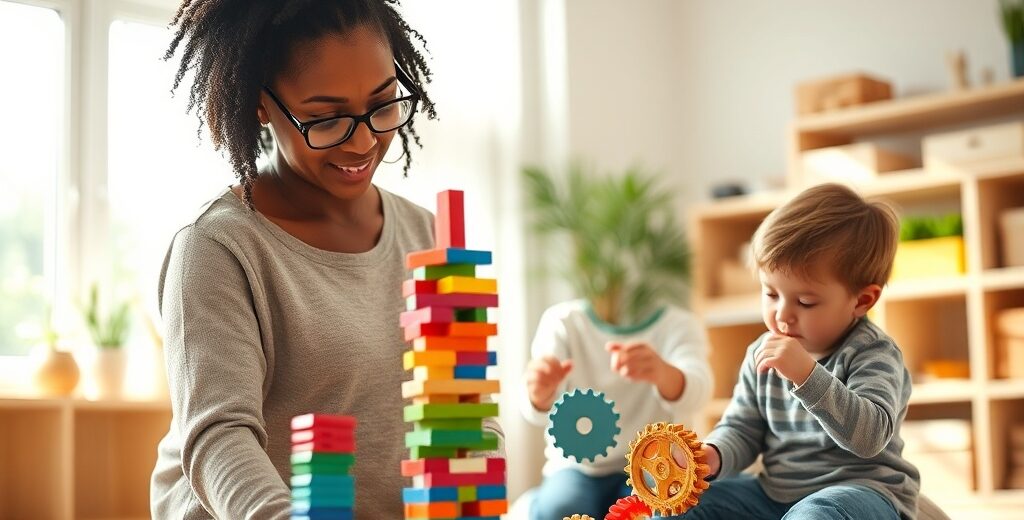
Choosing the Best STEM Toys for Kids Aged 3: A Montessori Educator’s Perspective
Hello, fellow parents and educators! My name is Elena, and I’m a devoted Montessori educator with a passion for early childhood development. Today, I want to share with you one of my favorite topics: selecting the best STEM toys for our curious three-year-olds. In this detailed guide, we will navigate through meaningful playtime while nurturing our children’s intrinsic love for learning.
Understanding the Montessori Approach to STEM
The Montessori method emphasizes hands-on, experiential learning. For this developmental stage, incorporating STEM (Science, Technology, Engineering, and Math) toys in accordance with Montessori principles can significantly enhance a child’s learning experience. A three-year-old’s world is filled with wonder, and it is at this phase that educators and parents can scaffold their understanding of complex concepts through structured play.

The Role of Play in Cognitive Development
Play is the language of childhood; it’s how kids interpret, process, and engage with their surroundings. For three-year-olds, integrating play with STEM concepts can be the cornerstone for future academic pursuits. At this tender age, children are naturally inquisitive, constantly asking questions about how the world works. By using versatile STEM toys, we can provide them with the tools to explore their questions actively, leading to cognitive and spatial understanding.
Take, for example, simple building blocks. To an adult, they might merely be a pastime, but to a child, they represent a miniature world of architectural possibilities, gravity lessons, and spatial intelligence.
A Curated List of Ideal STEM Toys for 3-Year-Olds
In my experience, not all toys labeled as “STEM” toys provide the developmental benefits that align with Montessori principles. Here’s a list of carefully selected toys that I have found to engage young learners effectively:
- Magnetic Tiles: A fantastic way to explore shapes and structures, these tiles use strong magnets to create stable, yet dynamic structures. Children can learn geometric principles while having the flexibility to imagine and create.
- Simple Robotic Kits: Kits specifically designed for younger children that introduce them to the fundamentals of programming and robotics in an age-appropriate manner.
- Interlocking Gears: Sets that allow children to connect gears in numerous ways, teaching them about cause and effect as well as enhancing their motor skills.
- Counting Bears with Sorting Bowls: A delightful introduction to counting, sorting, and color recognition in a playful manner.

Balanced Playtime: Integrating STEM with Life Skills
While it’s essential to provide children with toys that stimulate their intellectual growth, it’s equally crucial to integrate these with daily life skills. Encouraging children to engage in activities that include sorting laundry by colors or counting the number of spoons needed for dinner can turn mundane tasks into exciting adventures full of learning opportunities.
For instance, when a child uses a magnetic tile set to replicate a familiar shape, such as their house, they are not only learning fundamental STEM concepts but also applying and connecting those ideas to their real-world scenarios.
Nurturing a Learning Environment at Home
Creating a space at home that supports a child’s exploration can be as simple as setting up a designated play area where creativity and curiosity are encouraged. It’s about allowing play to lead and letting children guide their own learning journey. Montessori-inspired environments are calm, organized, and filled with accessible learning materials, sparking curiosity and discovery naturally.
Parents can enhance this learning by engaging in play with their children, asking open-ended questions, and encouraging children to predict outcomes. Such interactions not only reinforce their learning but also strengthen the bond between parent and child.

Reflecting on the Journey of Early Learning
Watching a child grow through play is a privilege and a magical experience. As parents and educators, our role is to provide the tools and environment that allow their natural curiosity to flourish. By selecting thoughtful STEM toys, sharing in their explorations, and guiding them with love and understanding, we lay the foundation for lifelong learning.
I hope this insight into selecting the best STEM toys for three-year-olds inspires you to explore new avenues of learning with your child. Let’s nurture their potential and watch as they build, create, and imagine their way into the future.
Happy parenting and teaching!
From the Shopmader Community
Real voices. Real play. We value every parent’s honest journey.