
Developmental toys are more than just fun and games; they’re tools that actively shape a baby’s cognitive, motor, and social-emotional skills during their crucial first years. Choosing the right toys can significantly contribute to a child’s healthy development and set them up for future success. This guide explores the best developmental toys for babies, categorized by key developmental areas.
Key Takeaways
- Developmental toys enhance cognitive, motor, and social-emotional skills in babies.
- Toys should be age-appropriate and aligned with specific developmental milestones.
- Look for toys that encourage exploration, problem-solving, and interaction.
- Safety is paramount: choose toys made from non-toxic materials and with no small parts.
- Variety is key: offer a range of toys to stimulate different areas of development.
Cognitive Development Toys
Cognitive development refers to the growth of a baby’s ability to think, reason, and understand the world around them. Toys that stimulate cognitive development encourage exploration, problem-solving, and memory skills.
- Mobiles (0-4 months): Suspended mobiles with contrasting colors and gentle movement capture a baby’s attention and stimulate visual tracking. Opt for mobiles with different textures and sounds as they grow.
- Black and White Toys (0-6 months): Newborns can see high-contrast images more easily, so black and white toys foster visual development and focus. Consider soft books or plush toys with bold patterns.
- Activity Gyms (0-6 months): Activity gyms with hanging toys encourage reaching, grasping, and tummy time, which strengthens neck and core muscles while stimulating visual and tactile exploration. Activities with sound and lights add to the engagement.
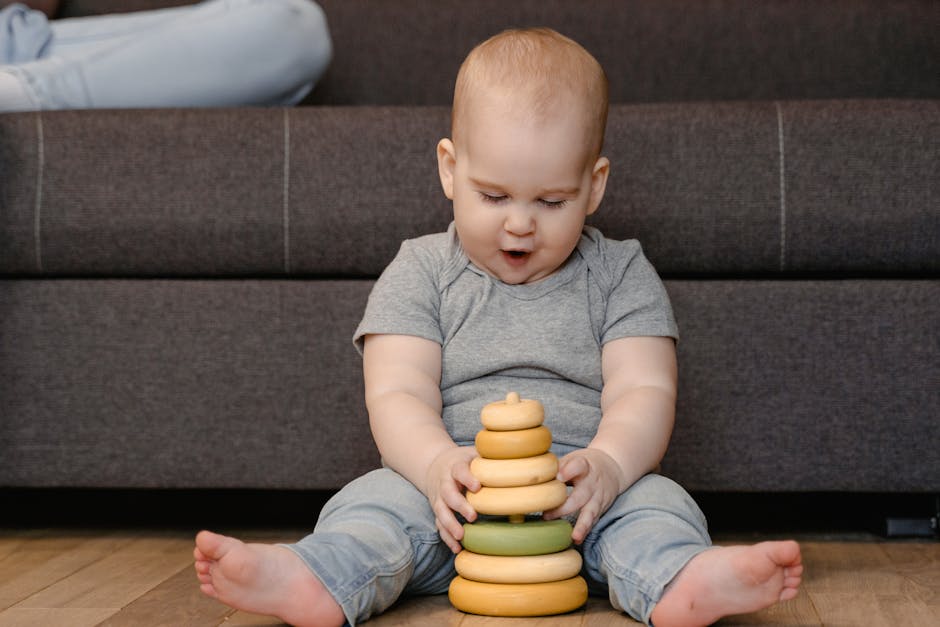
- Stacking Rings (6+ months): Stacking rings help babies develop hand-eye coordination, spatial reasoning, and problem-solving skills. Look for rings of varying sizes and textures to add sensory stimulation.
- Shape Sorters (9+ months): Shape sorters teach babies about different shapes and colors, while improving fine motor skills and problem-solving abilities. Choose sorters with chunky pieces that are easy for little hands to grasp.
Motor Skill Development Toys
Motor skills are essential for a baby’s physical development, enabling them to move, explore, and interact with their environment. Toys that enhance motor skills focus on both gross motor skills (large movements) and fine motor skills (small, precise movements).
- Rattles (0-6 months): Rattles are easy for babies to grasp and shake, helping them develop hand strength and coordination. The sound of the rattle stimulates auditory development.
- Soft Blocks (6+ months): Soft blocks are perfect for stacking, building, and knocking down, which encourages gross motor skills and hand-eye coordination. They’re also safe for chewing and mouthing.
- Push and Pull Toys (9+ months): As babies begin to crawl and walk, push and pull toys encourage them to move and explore their surroundings. Choose toys that are sturdy and easy to grip.
- Balls (12+ months): Balls are versatile toys that promote gross motor skills, hand-eye coordination, and social interaction. Start with soft, lightweight balls and progress to larger, bouncier ones as the baby grows.
- Ride-On Toys (18+ months): Ride-on toys help toddlers develop balance, coordination, and gross motor skills. Choose toys that are stable and low to the ground to prevent accidents.
Social-Emotional Development Toys
Social-emotional development is crucial for a baby’s ability to form relationships, understand emotions, and interact with others. Toys that promote social-emotional development encourage interaction, communication, and empathy.
- Mirrors (0+ months): Babies love to look at themselves, and mirrors help them develop self-awareness and visual tracking skills. Choose baby-safe mirrors that are shatterproof and easy to clean.
- Soft Dolls and Plush Toys (6+ months): Soft dolls and plush toys provide comfort and security, and can be used for role-playing and imaginative play. Choose dolls with diverse features and expressions to promote inclusivity.
- Puppets (9+ months): Puppets encourage storytelling, communication, and emotional expression. Use puppets to act out stories, songs, and rhymes, and encourage the baby to participate.
- Interactive Books (12+ months): Interactive books with flaps, textures, and sounds stimulate curiosity and encourage interaction. Choose books with simple stories and colorful illustrations.
- Play Kitchens (18+ months): Play kitchens encourage role-playing, social interaction, and imaginative play. They also help toddlers develop fine motor skills and learn about healthy food choices.
Safety Considerations When Choosing Toys
Safety is paramount when choosing developmental toys for babies. Always check the age recommendations on the packaging and choose toys that are appropriate for the baby’s developmental stage.
- Non-Toxic Materials: Choose toys made from non-toxic materials that are free from harmful chemicals like BPA, phthalates, and lead.
- No Small Parts: Avoid toys with small parts that could be a choking hazard. Test toys by running them through a toilet paper roll – if it fits, it’s too small.
- Durable Construction: Choose toys that are durable and can withstand rough play. Check for loose seams, sharp edges, and other potential hazards.
- Regular Inspection: Regularly inspect toys for damage and discard any that are broken or worn.
- Cleaning: Clean toys regularly to prevent the spread of germs.
By carefully selecting developmental toys that are age-appropriate, safe, and stimulating, parents can play an active role in fostering their baby’s healthy development. Remember that variety is key, so offer a range of toys that target different developmental areas. With the right toys and a little bit of playtime, you can help your baby reach their full potential!
Expert Editorial Disclosure
Verified by the Shopmader Editorial Team. Every toy is evaluated for safety, sensory value, and educational merit based on 2026 development standards.